The Return to the Digital Jungle: The Strange Case of the Sapiens Who No Longer Wish to Be One
About 70,000 years ago, Homo sapiens experienced a Cognitive Revolution. It was not the invention of better stone tools that made us masters of the planet, but our unique capacity to speak about things that do not exist. We became able to create fictions: gods, nations, money, and human rights. These fictions enabled millions of strangers to cooperate. Yet in the 21st century we are witnessing an ironic evolutionary turn: we are using that same capacity to create fictions not to build empires, but to deconstruct our own biology.
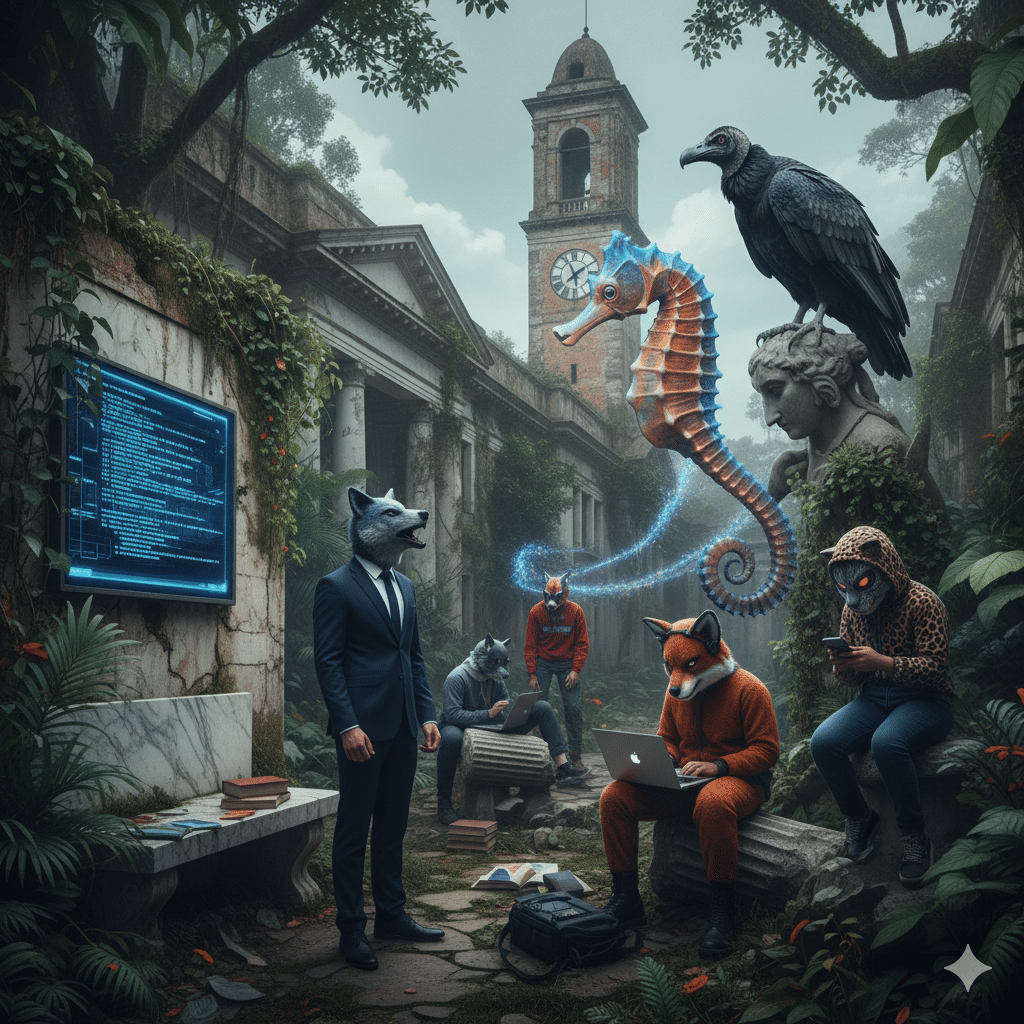
The emergence of the Therian trend (the word derives from the Ancient Greek thērion —θηρίον— meaning simply “beast” or “wild animal”), individuals who identify, on a deep and spiritual level, as non-human animals, is not merely a passing internet fad. It is the clinical symptom of a species that has lost faith in its own narrative. When a student in the corridors of the Central University of Venezuela (UCV) decides that their “true self” is a seahorse, a canine, or a feline, they are not simply playing a game; they are fleeing a human reality that has become too heavy, too bureaucratic and, fundamentally, too bizarre. A phenomenon that could also occur in private universities such as the Andrés Bello Catholic University and the Metropolitan University. Therein lies the seriousness of the matter.
The Collapse of Collective Fictions
To understand a Therian, we must first understand what it means to be “human”. Biologically, we are mammals with an oversized brain. Socially, however, the “human” is a legal and cultural construction. For centuries we told ourselves that we were the pinnacle of creation, bearers of a soul, or citizens of a progressive republic. These stories gave meaning to suffering and imposed order on chaos.
Yet in places such as Latin America, where institutions crumble and the promises of modernity increasingly resemble a swindle, the narrative of the “productive citizen” has lost its appeal. At the UCV, an institution designed to forge the communicators and scientists of the future, the appearance of young people identifying as beasts is an unconscious protest. If the educational, economic and political system of your country cannot offer you a dignified human life, the psyche seeks refuge in an identity that pays no taxes, requires no passport and does not suffer from inflation. The animal is free by definition; the Venezuelan citizen today is a hostage to circumstance.
This alienation is the result of a short circuit between our ancestral biology and a hyper-technological environment. We live in concrete cities, glued to screens that bombard us with algorithms, yet our cerebral operating system remains that of a hunter-gatherer from the savannah. When the pressure of maintaining a perfect LinkedIn profile becomes unbearable, the idea of being a wolf — a creature of pure instinct and authenticity — becomes an irresistible fantasy.
The State’s Reaction: The Argentine Case and the Frontier of Law
Politics always arrives late to biological changes, but when it arrives, it does so forcefully. The case of Argentina and the positions associated with Javier Milei represent a head-on collision between absolute individual liberty and the State’s need to define what constitutes a “legal subject”. From a libertarian or rational right-wing perspective, markets and societies function on the premise that individuals are responsible agents. If a citizen renounces their humanity to embrace an animal identity, they break the basic contract of civilisation.
The supposed “illegalisation” or political rejection of such movements in parts of the Southern Cone is not merely a matter of cultural conservatism; it is a struggle over objective reality. The State requires you to be human in order to tax you, for you to vote, and for you to be subject to the law. A “dog” cannot sign a contract; a “cat” cannot be tried for malpractice. By invalidating these tendencies, governments attempt to shore up the edifice of shared reality that is beginning to crack.
What we are witnessing is a battle for the monopoly of identity. If identity becomes purely subjective (“I am what I feel”), the very structure of large-scale cooperation risks dissolving. If tomorrow ten million people decide they are migratory birds and no longer recognise borders or aviation law, the system collapses. The “bizarreness” we perceive in Therians is, in fact, the sound of the glass of the Enlightenment shattering.
The Paradox of the Digital Beast
Here lies the most delicious and cruel irony of our time: Therians employ the most advanced technology in human history — social networks, optical sensors, carbon-fibre components in their masks — to express a desire to return to the primitive. It is a technological rebellion against technology itself.
Across the world, from Japan to Europe, the phenomenon repeats itself. It is not a lack of information but an excess of it. We are so saturated with “constructed identities” in the digital world that real biology begins to feel like a prison. We want to be fluid. We want to be “other”. Yet this desire to be animals is, paradoxically, the most human impulse imaginable. No real wolf has ever spent an afternoon wondering whether it is in fact an accountant trapped in the body of a canine. Only humans possess the tragic capacity to disagree with their own DNA.
This alienation is a cry for help from our animal side, suffocating in cubicles and classrooms that no longer promise a future. The Therian movement is the distorted mirror of a society that has forgotten how to nourish the human spirit, offering instead only consumption and bureaucracy. When human life becomes an office simulation, the jungle — even if imaginary — begins to seem like the only real place left.
Conclusion: The Challenge of Becoming Sapiens Again
The lesson of this phenomenon is not that we should persecute or ridicule those who feel themselves to be animals, but that we must ask what we are doing so badly that being human has become such an unattractive offer. If young people prefer to identify with beasts rather than with the project of their own nation, the problem is not the costume but the emptiness beneath it.
The call to action is urgent and vital: we must return to living as humans of flesh and blood. This does not mean abandoning technology, but subordinating it to our nature. It means recovering physical contact, direct gaze, genuine effort, and a connection with the material world that cannot be edited with a TikTok filter. Being human is a difficult task; it requires accepting our biological limitations, our mortality, and our responsibility to others.
To live as humans means reclaiming sovereignty over algorithms. It means understanding that our true essence lies not in an avatar — whether digital or plush — but in our capacity to reason, to create beauty, and to build societies grounded in truth rather than delusion. The next time you see someone attempting to escape their humanity, do not look first at their mask; look at the world we have built and ask why anyone would wish to flee from it. It is time to make being human worthwhile again.
“Science is more than a body of knowledge; it is a way of thinking. If we are not able to ask sceptical questions, to interrogate those who tell us that something is true, then we are at the mercy of the next charlatan, politician, or belief system that comes along.” — Carl Sagan
Gustavo Alberto Añez Serpa (Instagram: @gustavotaichi) y
Dayana Cristina Duzoglou